The Sound of Silence. The Frequency of the Heart.
There is a space within you that is untouched by expectation, free from the noise of the world.
A space of pure, crystal-clear light.
The ancient Indian string instrument Esraj is the key to this threshold. In the hands of Deno, its sound balances delicately on the ridges of culture — sounding like a sunrise in Rajasthan, moving between sacred classical depth and avant-garde nuance.
It walks on quiet soles for fine ears. And those who truly open them, can hear it glisten. When bow and string meet, it is no longer just music. It is a pure, acoustic heart resonance. The high-frequency vibrations pierce gently through the layers of the mind, aligning you directly with the frequency of deep forgiveness and unconditional self-love.
One deep breath.
A pure arrival.
Let the resonance unfold.
Feel the light within.
Why Sacred Esraj?
Centering and inner joy are cultivated far more easily together than alone:
The centuries-old frequencies of Sacred Esraj grant your festival community a profound, collective arrival in the here and now.
Dates
Sacred Circle @ Herbstzauber Aromareich
Oct 10th
Aromareich
Oberwinklerner Weg 28
A-9231 Köstenberg

Sacred Circle & Tribal Energy /w Bintang Manik
Oct 3rd, details t.b.a.
Vitality Base
Leberstraße 118A,
A-1110 Wien

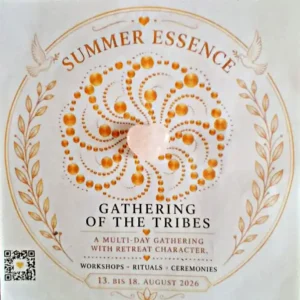
Sacred Circle@ Essence Gathering
Sat., Aug 15th
6:30 pm
Seebühne Fernitz
194 Murbergstraße
8072 Enzelsdorf bei Graz


Entfaltungsfest
July 16th-26th
Seebühne Fernitz
194 Murbergstraße
8072 Enzelsdorf bei Graz


Modules
The Sacred Circle
Duration:
40–60 minutes
Format:
Meditative Experience / Deep Listening (seated or lying down).
The Vibe:
A collective sanctuary of release and pure presence. The ancient, deep frequencies of the Esraj act as a profound acoustic anchor. In a world where centering alone can often feel challenging, this format creates a powerful, deeply held group experience. A true, cellular arrival in the here and now.
Tribal Energy
Duration:
Flexible (30–90 minutes)
Format:
Ecstatic Live Set / Collaboration (Esraj + Percussion & Live Elements)
The Vibe:
The sacred instrument transcends silent meditation to ignite a rhythmic, grounding fire. Moving in tandem with driving percussion, the Esraj evokes an archaic, pulsing energy that moves directly into the body. Here, meditative depth and trance-like movement merge into a cohesive, elevating experience designed for the festival’s peak moments.
Sound Ritual / Ceremonial
Duration:
Multiple short bursts (2–5 minutes each)
Format:
Energetic sonic impulses / Openers, closings, or structural interventions throughout the gathering.
The Vibe:
The ultimate bridge for events, ceremonies, and gathering transitions. These highly compressed, immensely potent sonic offerings energetically cleanse the space, focus the crowd, and rituallly open, close, or punctuate the festival timeline. Perfect in between speeches or various programs.
Solo Esraj Meditations
Enjoy these carfully recorded Solo-Esraj Meditations in our custom web player, adapting the music to your desired length of meditation.

The Artist
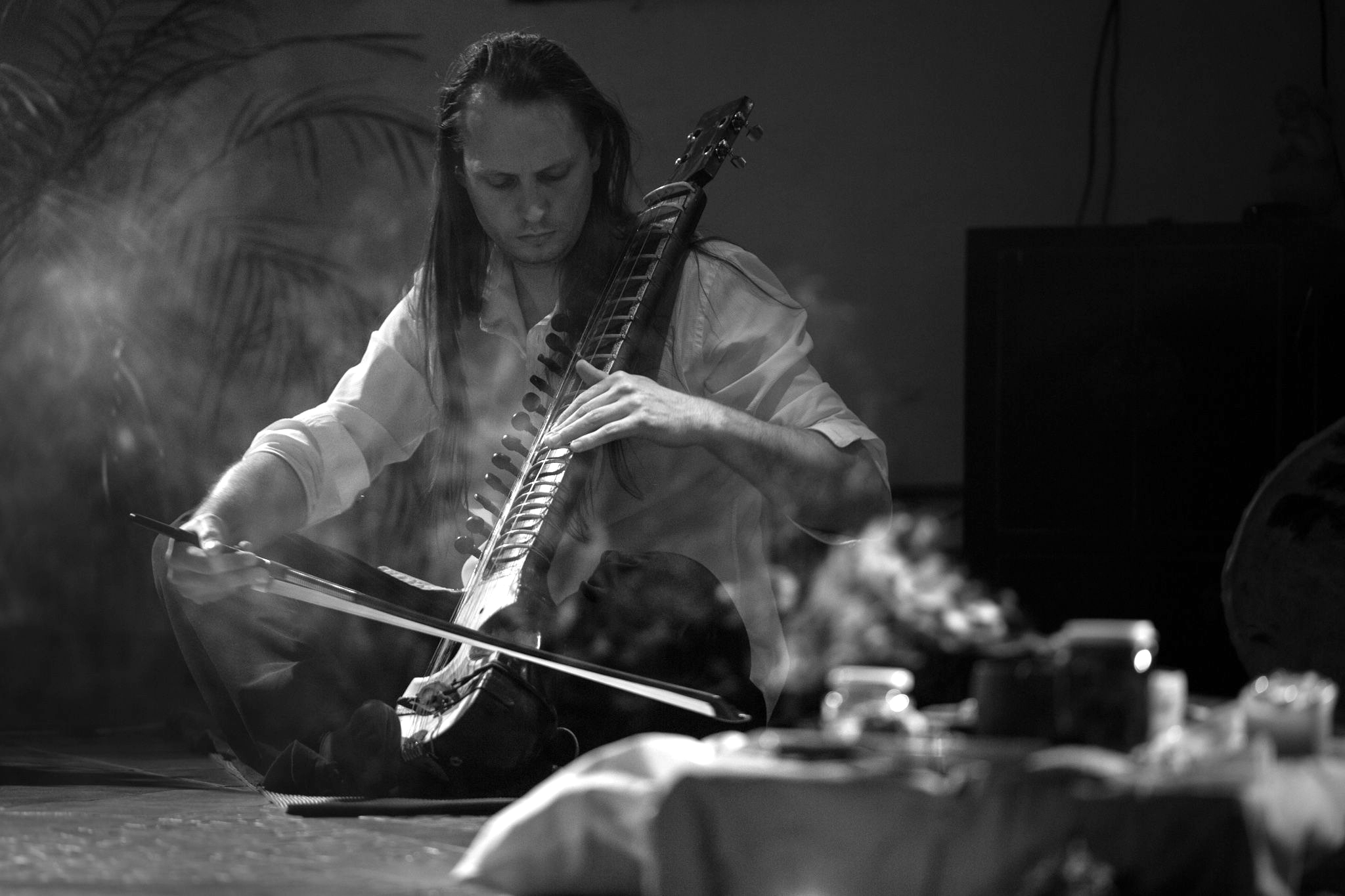
Deno is a composer and musician deeply dedicated to the ancient, expressive voice of the Esraj. As one of the few European experts on this rare Indian string instrument, he spent years studying in Delhi and Benares under traditional masters. His work gracefully bridges Western contemporary composition with traditional Indian ragas. In this space, everything revolves around acoustic heart resonance and the soulful vibration of the Esraj, inviting listeners into a space of deep peace.
The Instrument
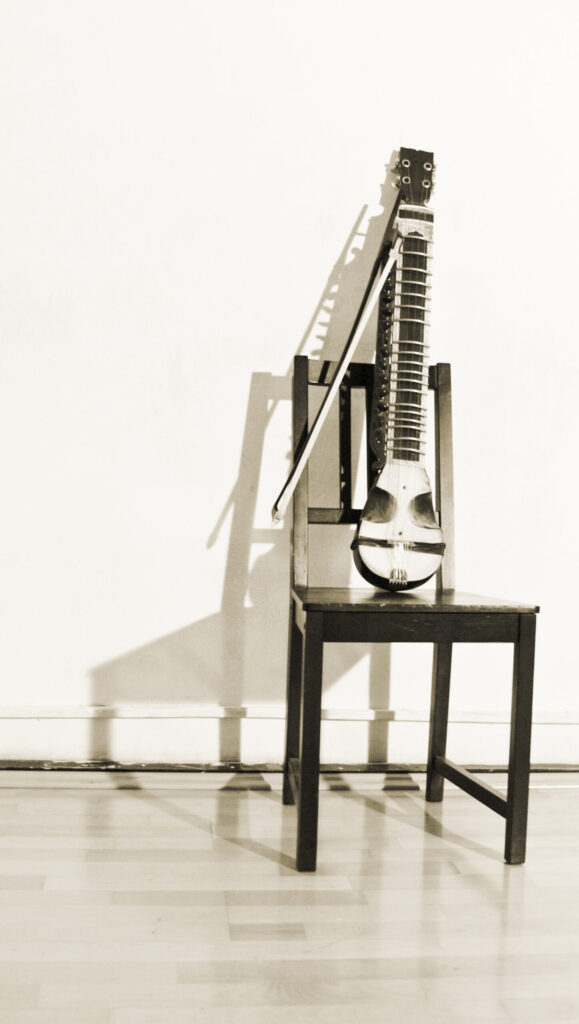
The Esraj, originating in the 17th century is by Indian terms quite a young instrument. It was derived from the Taus, played by the Sikh, which is considerably heavier and has a larger scale. 12-15 resonance strings are mounted on a wooden rack beside the neck, wich holds 18-20 metal frets. The soundboard is covered by goatskin, like a banjo, a horn bridge transports the sound into its body and reverbates in the hollow inside totally up to the neck. It usually has one main string and three bourdun strings. The Esraj is played with a bow (gaz), the typical Indian „meend“ and portamentos are performed while moving the hand alongside the strings. Bendings, like on the sitar, are not applied.
Esraj is played in sitting position on a carpet, but can be played on a stool as well while resting the body on the lap. Most players rest the neck on the left shoulder, others let the instrument stand freely, supported by the fingering hand.
The Esraj originates in folk – and spiritual music and was used for accompanying vocal recitals, though some notable players have used it as a solo instrument in raga.
Rabindranath Tagore, Indias prominent son, also made use of the Esraj in his poetic songs. In the 20th century the Esraj has become quite rare, nearly extinct, but is gaining popularity since the 1980s thanks to „Gurmat Sangeet“, a Sikh Kirtan style spiritual music. Nowadays it is mostly found in Pakistan, Nepal and the Indian region Bengal.
taken from “the esraj handbook”, denovaire 2016